
AutoPhish vs Playwriter
Side-by-side comparison to help you choose the right tool.

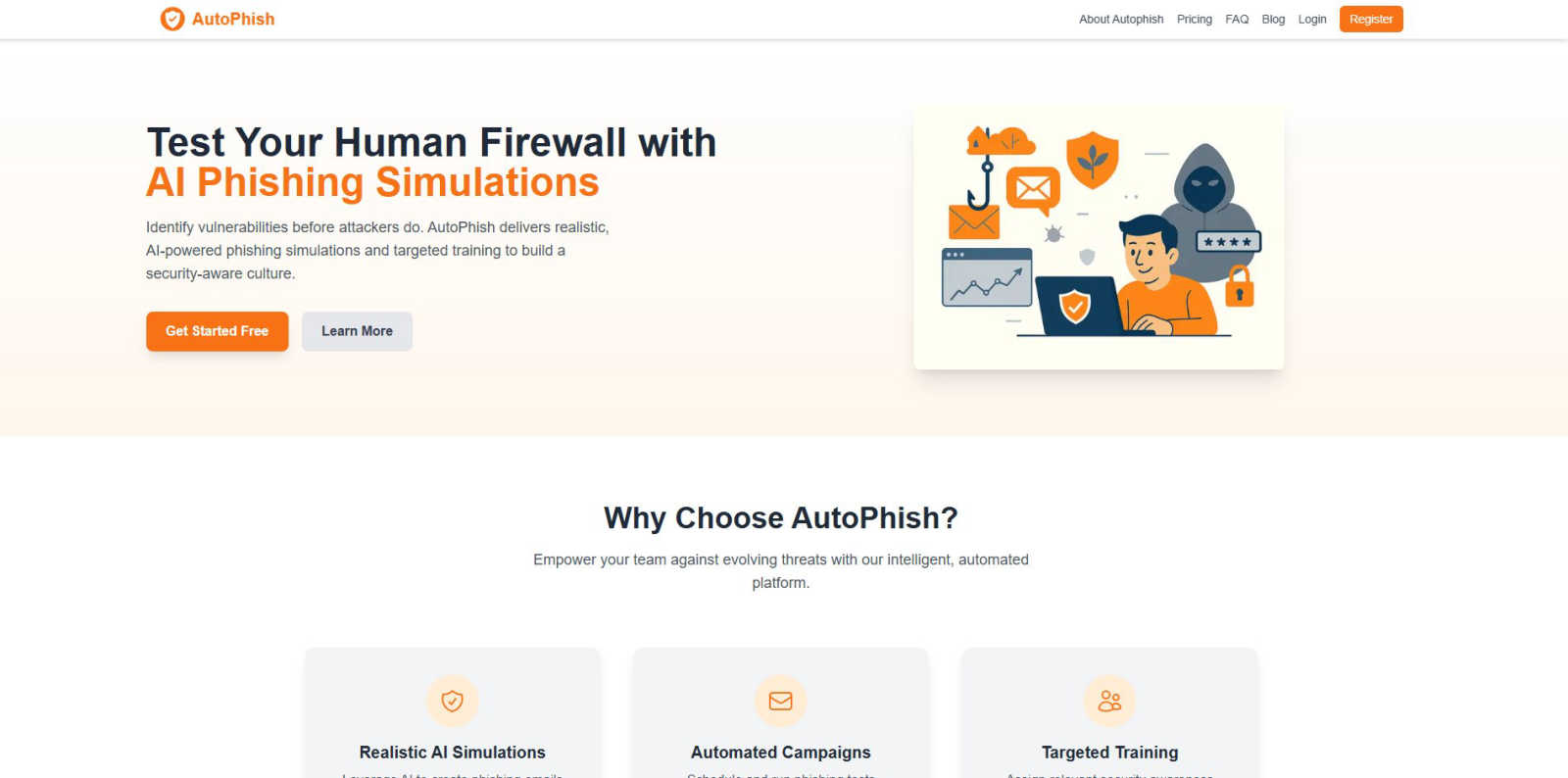
AutoPhish uses AI to run realistic phishing simulations and train your team against email threats.
Last updated: March 1, 2026

Playwriter
Playwriter lets AI agents control your real Chrome browser with all your logins and extensions intact.
Last updated: March 18, 2026
Visual Comparison
AutoPhish
Playwriter

Feature Comparison
AutoPhish
AI-Powered Realistic Phishing Simulations
Leverage cutting-edge generative AI to create phishing emails that are indistinguishable from real-world attacks. The AI analyzes current threat intelligence and tailors content, sender personas, and urgency to match your specific industry context, ensuring every test is a relevant, high-stakes learning experience that prepares employees for what they'll actually face.
Automated Campaign Management
Completely automate your phishing simulation program. Schedule campaigns weeks or months in advance, target specific user groups dynamically, and let the platform handle delivery and tracking. This ensures consistent, ongoing security testing without draining your team's resources on repetitive administrative tasks.
Performance-Based Targeted Training
Move beyond one-size-fits-all training. AutoPhish intelligently analyzes user interactions with simulations (clicks, data entry, reporting) and automatically assigns follow-up security awareness training modules that address their specific gaps. This personalized approach ensures education is relevant, impactful, and drives behavioral change.
Comprehensive Analytics & Reporting Dashboard
Gain deep, actionable insights into your organization's security posture. The platform provides advanced reporting on click-through rates, vulnerable departments, repeat offenders, and overall risk scores. Use these metrics to measure ROI, demonstrate compliance needs, and make data-driven decisions to strengthen your human layer.
Playwriter
Your Actual Browser Session
Forget spawning new, sterile Chrome instances. Playwriter's Chrome extension attaches directly to your open tabs, granting AI agents access to your real browsing environment. This means all your active logins (Google, GitHub, social media), installed extensions (password managers, ad blockers), and existing cookies are immediately available. This eliminates the biggest hurdles in web automation: authentication walls and instant bot detection systems that flag fresh, cookie-less browsers. Your agent works within your digital identity, making automation flows for logged-in services not just possible, but effortless.
Full Playwright API via MCP
Playwriter doesn't limit your AI with a pre-defined, restrictive set of tools. Instead, it exposes the entire, industry-standard Playwright automation API through a single MCP tool called execute. Your agent can write and run any Playwright code—clicking, typing, navigating, waiting for elements, taking screenshots, and more. This "one tool to rule them all" approach avoids the context-wasting bloat of dozens of individual tool definitions and gives your AI the flexibility to handle any complex, dynamic web interaction you can code, from performance profiling to complex multi-step workflows.
Advanced Debugging & Live Editing
This is where Playwriter transitions from an automation tool to a development powerhouse. It includes a built-in debugger that allows you to set breakpoints in the agent's Playwright script, pausing execution to inspect the page state. More impressively, it supports live code editing, letting you modify the automation script on-the-fly while it's running. Combined with network request interception and manipulation capabilities, this feature set enables you to rapidly debug, test, and refine automation scripts in real-time alongside your AI, turning the browser into an interactive development console.
Lightweight Accessibility Snapshots
Traditional full-page screenshots are slow and consume massive context (100KB+). Playwriter solves this with intelligent, accessibility-focused snapshots. These compact (5-20KB) snapshots capture the semantic structure of the page—all interactive elements, text, roles, and states—providing your AI agent with a perfect, low-context understanding of the page layout. This enables the AI to reliably choose the correct buttons, links, and form fields using robust selectors, dramatically improving accuracy and reliability while keeping your token usage efficient.
Use Cases
AutoPhish
Proactive Security Posture Assessment for IT Teams
Security teams use AutoPhish to conduct regular, automated phishing tests across the organization. This provides a continuous, data-driven assessment of the human risk landscape, identifying which departments or individuals are most vulnerable, allowing for targeted intervention before a real breach occurs.
Compliance and Audit Readiness
Organizations in regulated industries deploy AutoPhish to fulfill mandatory security awareness training requirements. The platform provides documented proof of ongoing employee testing and education, complete with detailed reports and metrics, making it effortless to demonstrate due diligence during audits for standards like ISO 27001, GDPR, or SOC 2.
Onboarding and Continuous Employee Education
HR and People Ops teams integrate AutoPhish into the employee lifecycle. New hires undergo simulated phishing tests as part of onboarding, while all employees receive periodic, automated campaigns. This ingrains security-conscious behavior from day one and maintains vigilance through continuous, relevant exposure.
Simulating Sophisticated Spear-Phishing Attacks
For advanced security maturity, teams use AutoPhish to craft and launch highly targeted spear-phishing campaigns against executive assistants, finance departments, or system administrators. This tests resilience against the most dangerous, personalized attacks and validates the effectiveness of advanced threat detection and reporting protocols.
Playwriter
AI-Assisted Web Research & Data Extraction
Supercharge your research. Instruct your AI agent to visit a series of websites, log in with your credentials, perform complex searches, navigate through pagination, and extract structured data from tables or articles. Because it uses your real session, it can access paywalled content, private dashboards, and personalized feeds that are completely off-limits to traditional scraping tools. The human collaborator simply solves the occasional CAPTCHA or consent dialog.
Automated Testing & QA with Human-in-the-Loop
Revolutionize your testing workflow. Developers can describe a user journey in natural language, and the AI agent can generate and execute the corresponding Playwright test script in a real browser. When the test encounters a flaky element or an unexpected UI change, the human tester can pause execution, live-edit the selector or action, and continue. This creates a powerful collaborative loop for building robust, user-acceptance-level tests.
Routine Admin & SaaS Operations
Automate the tedious daily grind. From generating reports in your business analytics dashboard, to managing user tickets in an admin panel, to posting scheduled content on social media platforms, Playwriter can handle it. The AI agent performs the repetitive, rule-based navigation and data entry within the logged-in web applications you use every day, freeing you for higher-value work while you remain in control.
Building and Demonstrating AI Agents
For builders in the AI space, Playwriter is an indispensable prototyping and demonstration tool. It allows you to quickly create agents that interact with real-world web services without building custom integrations for each one. You can demo an agent that books a flight, compares prices, or manages a Shopify store—all using the public web as its playground. The open-source MCP server makes it easy to integrate into any agent stack.
Overview
About AutoPhish
In today's hyper-connected digital landscape, your employees are the new perimeter. With AI-powered phishing attacks becoming frighteningly sophisticated and personalized, traditional security training is obsolete. AutoPhish is the cutting-edge, AI-driven platform engineered to turn your workforce from a vulnerability into your strongest line of defense. It's not just another training module; it's a proactive cybersecurity engine designed for organizations of all sizes that are serious about resilience. The platform revolutionizes security awareness by deploying hyper-realistic, AI-generated phishing simulations that perfectly mimic the latest attack vectors, from CEO fraud to credential-harvesting scams tailored to your specific industry. This allows you to proactively identify and patch human vulnerabilities before real attackers exploit them. Beyond simulation, AutoPhish automates the entire training lifecycle, freeing your security team from manual campaign management and delivering targeted, actionable training to users based on their simulation performance. Its core value proposition is clear: build a genuine, lasting culture of security awareness by continuously testing and educating your human firewall with the most advanced tools available, ensuring your organization stays ahead of evolving threats.
About Playwriter
Stop fighting with headless browsers and bot detection. The future of AI-powered web automation is here, and it's shockingly simple. Playwriter is the groundbreaking open-source tool that finally bridges the gap between your AI agents and the real, logged-in web. It's not another limited API wrapper or a fresh, suspicious browser instance. Instead, Playwriter gives your AI direct, programmatic control over your actual Chrome session—extensions, cookies, logins, and all. Think of it as a neural interface for your browser, enabling seamless human-AI collaboration. Built around the powerful Playwright framework and the emerging Model Context Protocol (MCP), it provides a single, elegant "execute" tool that unleashes the full automation potential of your AI assistant in Cursor, Claude Desktop, or VS Code. By operating within your existing browser, it eliminates memory bloat, bypasses instant bot detection, and allows you to supervise and collaborate in real-time. This is the paradigm shift developers and power users have been waiting for: true, contextual web automation that works with the internet as it actually exists.
Frequently Asked Questions
AutoPhish FAQ
How realistic are the AutoPhish simulations?
Extremely realistic. AutoPhish uses advanced AI to generate phishing email content that mirrors current real-world attack tactics, techniques, and procedures (TTPs). You can customize simulations with your company's branding, industry-specific lingo, and common internal communication styles, making them nearly indistinguishable from legitimate messages and providing a true test of employee vigilance.
Is it safe to send simulated phishing emails to my own employees?
Absolutely. Safety and security are paramount. AutoPhish requires you to verify domain ownership, ensuring simulations are sent securely. The platform operates with clear ethical guidelines, all simulated activity is contained within the platform for analysis, and no real malicious software or links are used. It's a controlled, educational environment designed to build awareness, not cause harm.
What happens if an employee fails a simulation?
Failure is a critical learning opportunity. When an employee interacts with a simulated phishing email, AutoPhish can be configured to display an immediate, instructive message explaining what they missed. The system then flags the user and can automatically enroll them in mandatory, targeted training modules specifically designed to address the type of phishing tactic they fell for, turning a mistake into a teachable moment.
Can I track the progress and ROI of the training program?
Yes, comprehensively. AutoPhish provides a detailed analytics dashboard that tracks key metrics over time, including overall phishing susceptibility rates, department-by-department performance, repeat click rates, and training completion. You can measure the improvement in your human firewall's resilience and generate reports to demonstrate the program's effectiveness and ROI to leadership.
Playwriter FAQ
How is Playwriter different from other browser automation MCP servers?
Most other solutions take one of two flawed approaches: they either launch a new, "clean" Chrome instance (which lacks logins and gets detected as a bot) or they provide a limited, fixed set of tools (which restricts what the AI can do). Playwriter is unique. It connects to your existing, authenticated Chrome session, bypassing bot detection, and provides the full, unrestricted Playwright API through a single, powerful execute tool. This gives your AI maximum capability with minimal context overhead.
Is my browsing data secure with Playwriter?
Absolutely. Playwriter is designed with a strong privacy-first architecture. All communication happens via a WebSocket relay that runs exclusively on your local machine (localhost:19988). No browsing data, cookies, or automation scripts are sent to any remote server. The connection is strictly between the Chrome extension on your browser and the CLI or MCP client on your computer. You maintain complete control and ownership of your data.
Can I use Playwriter with any AI assistant or IDE?
Yes, thanks to the Model Context Protocol (MCP). Playwriter includes an MCP server that is compatible with any client that supports the protocol. This includes popular AI-powered IDEs like Cursor and Windsurf, desktop assistants like Claude Desktop, and code editors like VS Code with the appropriate MCP extension. The open-source nature means integration is standardized and widespread.
What happens if the AI gets stuck or hits a CAPTCHA?
This is where Playwriter's collaborative design shines. You are watching the automation happen in real-time in your browser. If a CAPTCHA appears, a consent wall pops up, or the agent seems confused, you can immediately intervene. You can solve the CAPTCHA yourself, click the necessary button, or even temporarily disable the extension on that tab to manually fix the state. Once you re-enable it, the agent can continue from where it left off, creating a true human-AI partnership.
Alternatives
AutoPhish Alternatives
AutoPhish is a leading AI-powered platform in the Business Intelligence and Productivity & Management space, designed to fortify organizational email security through automated phishing simulations and targeted training. It's a critical tool for building a human firewall against evolving cyber threats. Users often explore alternatives for various reasons, including budget constraints, the need for different feature sets like broader security awareness training, or specific integration requirements with their existing tech stack. The search for the right fit is a common step in the cybersecurity procurement process. When evaluating other solutions, prioritize platforms that offer hyper-realistic, AI-driven simulations that mirror current attack vectors. Look for automated campaign management to save time, and ensure the tool provides actionable analytics and personalized training paths to turn vulnerable clicks into vigilant employees.
Playwriter Alternatives
Playwriter is an open-source automation tool that gives AI agents direct, authenticated control of your actual Chrome browser session. It solves the critical problem of agents working in isolated, "fresh" browser instances that lack logins, extensions, and context, making real web interaction possible. This places it squarely in the trending category of AI-native browser automation and MCP (Model Context Protocol) tooling. Users explore alternatives for various reasons. Some need a solution for a different browser like Firefox or Safari, while others may prioritize a fully hosted service over an open-source toolkit. Specific feature needs, such as mobile device testing, different licensing models, or integration with a particular development stack, also drive the search for other options. When evaluating alternatives, key considerations include the depth of browser integration, support for authenticated sessions, the quality of debugging tools, and compatibility with your existing AI agent clients. The core value lies in enabling reliable, stateful automation that mirrors a real human's browsing environment, so any alternative should credibly address that fundamental challenge.