
DevUtilX vs HookMesh
Side-by-side comparison to help you choose the right tool.
DevUtilX
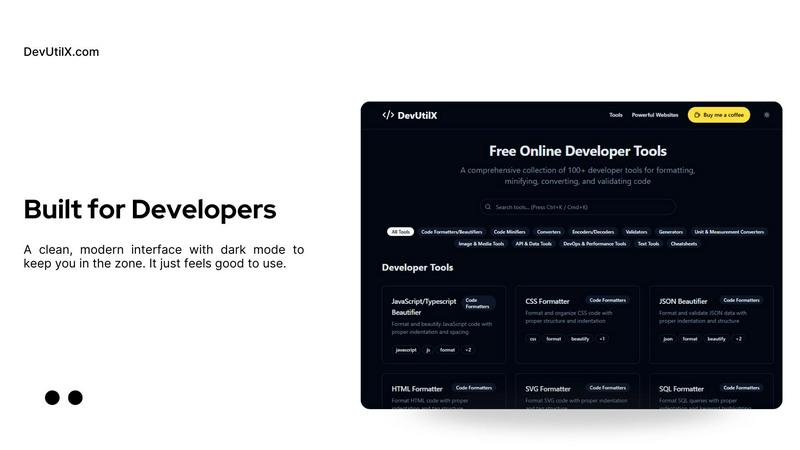
DevUtilX offers 100+ essential online tools for developers to format, validate, convert, and optimize code effortlessly.
Last updated: March 1, 2026

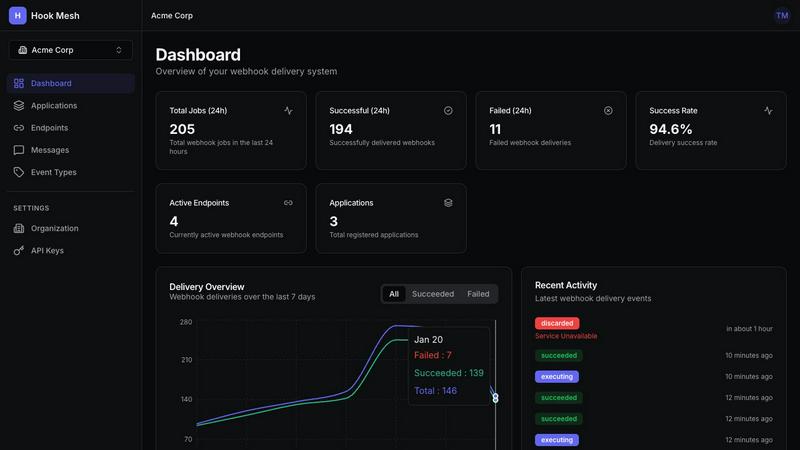
HookMesh delivers reliable webhooks with automatic retries and a self-service customer portal for SaaS.
Last updated: February 28, 2026
Visual Comparison
DevUtilX
HookMesh
Feature Comparison
DevUtilX
Comprehensive Tool Suite
DevUtilX boasts over 100 developer tools, covering everything from code formatting to data conversion. This extensive collection ensures that developers have all the utilities they need at their fingertips, simplifying their coding tasks and enhancing efficiency.
Multi-Language Support
The platform supports a broad range of programming languages, including JavaScript, Python, HTML, and CSS. This versatility makes DevUtilX an essential toolkit for developers working across various projects and tech stacks, ensuring that no matter the language, they have the tools required for success.
Local Data Processing
With a strong focus on privacy, all processing in DevUtilX occurs locally within the user's browser. This approach not only secures sensitive data but also enhances performance, as no data is sent to external servers during tool usage, allowing for faster processing times and a safer coding experience.
User-Friendly Interface
DevUtilX features an intuitive and user-friendly interface designed to cater to both novice and experienced developers. The seamless navigation and easy-to-use tools reduce the learning curve, enabling developers to quickly adopt the platform and enhance their productivity.
HookMesh
Reliable Delivery Engine
HookMesh's core is a battle-tested delivery system designed for the unpredictable nature of the web. It guarantees at-least-once delivery using idempotency keys, ensuring no event is lost even during retries. The system employs sophisticated exponential backoff with jitter, intelligently retrying failed deliveries for up to 48 hours without overwhelming downstream endpoints. An automatic circuit breaker proactively disables endpoints that are consistently failing, preventing one problematic customer from backing up your entire queue and affecting others' delivery performance.
Self-Service Customer Portal
Shift the burden of endpoint management from your support team directly to your users with HookMesh's embeddable customer portal. This white-labeled UI can be dropped directly into your application, providing your customers with full autonomy. They can add, verify, and manage their own webhook endpoints, view complete delivery logs with request and response details, and instantly replay any failed webhook with one click. This dramatically reduces support tickets and increases customer satisfaction through transparency.
Developer-First SDKs & Tools
HookMesh is built to integrate in minutes, not months. It offers official, well-maintained SDKs for popular languages like JavaScript, Python, and Go, allowing you to send events with just a few lines of code. Beyond the SDKs, developers get access to a full REST API for programmatic control and a Webhook Playground to test, debug, and validate event payloads and signatures before going live, ensuring a smooth development and debugging experience.
Comprehensive Visibility & Control
Gain operational mastery over your webhook ecosystem. HookMesh provides detailed delivery logs with full HTTP request and response traces, eliminating the need to dig through server logs for hours. Combined with the customer portal, this creates a transparent feedback loop. Furthermore, features like configurable retry policies, event replay, and webhook signature verification give you and your customers complete control and confidence in the delivery pipeline.
Use Cases
DevUtilX
Quick Code Formatting
Developers can use DevUtilX to quickly format their code, ensuring it adheres to best practices and is easy to read. This is particularly useful in collaborative environments where coding standards must be maintained across different team members.
Efficient Code Minification
When preparing for production, developers can leverage the minification tools of DevUtilX to significantly reduce file sizes. This process not only optimizes load times but also enhances overall application performance, making it invaluable for web development.
Seamless Data Conversion
With the array of converters available, users can effortlessly convert files between different formats. This feature is essential for developers who frequently work with various data types, ensuring smooth transitions and compatibility across different systems.
Reliable Code Validation
DevUtilX provides robust validation tools that help developers catch errors early in the coding process. By validating code across multiple languages, developers can ensure their applications are error-free, improving the overall quality of their work.
HookMesh
SaaS Platform Notifications
For platforms like project management tools, CRM systems, or financial dashboards, real-time notifications are critical. HookMesh enables these platforms to reliably push events—like a new comment, a deal stage change, or a budget alert—to their customers' external systems. The self-service portal allows customers to set up their own integrations without requiring platform developers to manually configure each endpoint, enabling massive scalability.
E-commerce & Payment Processing
E-commerce engines and payment processors need guaranteed delivery of order confirmations, shipment updates, and payment success/failure events to merchant ERPs, accounting software, and logistics systems. HookMesh's at-least-once delivery and 48-hour retry logic ensure critical financial and operational data is never lost, even if the merchant's system experiences temporary downtime.
DevOps & CI/CD Automation
Modern DevOps teams use webhooks to trigger pipelines, deployments, and alerts across tools like GitHub, GitLab, and monitoring platforms. HookMesh ensures these automation triggers are never missed. If a deployment orchestration tool is temporarily unavailable, HookMesh will persistently retry, preventing automation breakdowns and maintaining continuous delivery flows without manual intervention.
IoT & Real-Time Data Streaming
IoT platforms that aggregate sensor data and need to forward processed events to customer applications or data lakes require a robust, fire-and-forget delivery system. HookMesh handles the high volume and variable connectivity of IoT endpoints, using circuit breakers to sideline unresponsive receivers and ensuring data flows consistently to all active and healthy systems.
Overview
About DevUtilX
DevUtilX is the ultimate web-based toolkit tailored for developers, featuring a powerful suite of over 100 essential tools that streamline various programming tasks. This platform is designed for everyone, from seasoned professionals to budding developers, eliminating the need for installations or downloads. With DevUtilX, users can effortlessly format, minify, convert, and validate code directly in their browsers, allowing them to focus on coding without distraction. The tool supports multiple programming languages including JavaScript, Python, HTML, and many more, making it an indispensable resource across diverse tech stacks. Its commitment to user privacy guarantees that all data processing happens locally, keeping your sensitive information secure. With features aimed at enhancing productivity and simplifying workflows, DevUtilX stands as the go-to solution for developers seeking to save time and elevate the quality of their code.
About HookMesh
In the fast-paced world of modern SaaS, real-time data flow isn't a luxury—it's the lifeblood of user experience and system integration. Yet, building the infrastructure to power this, specifically webhooks, is a notorious time-sink that derails developer velocity. Enter HookMesh: the battle-tested, developer-first platform engineered to eliminate the chaos of in-house webhook delivery. This isn't just another middleware; it's a complete operational shift. HookMesh provides the robust, scalable infrastructure so your team can stop worrying about retry logic, circuit breakers, and debugging "ghost" deliveries, and start focusing on your core product innovation. Designed for developers and product teams at scaling SaaS companies, HookMesh delivers peace of mind through guaranteed reliability and unparalleled visibility. Its killer feature? A fully embeddable, self-service customer portal that turns webhook management from a support nightmare into a user empowerment tool, allowing your customers to manage endpoints, view live logs, and replay failures with a single click. In an era where API reliability is a direct reflection of your brand, HookMesh ensures your event-driven architecture is a competitive advantage, not a technical debt trap.
Frequently Asked Questions
DevUtilX FAQ
What types of programming languages does DevUtilX support?
DevUtilX supports a wide range of programming languages including JavaScript, Python, HTML, CSS, SQL, and more, catering to the diverse needs of developers.
Is DevUtilX free to use?
Yes, DevUtilX offers a comprehensive collection of tools for free, allowing developers to access high-quality utilities without any financial commitment.
Do I need to install any software to use DevUtilX?
No, DevUtilX is a web-based toolkit that does not require any installations or downloads. Simply access the platform through your browser to start using the tools.
How does DevUtilX ensure data privacy?
DevUtilX processes all data locally within the user's browser, which means no information is sent to external servers. This privacy-focused approach keeps your data secure while you work.
HookMesh FAQ
How does HookMesh guarantee webhook delivery?
HookMesh guarantees at-least-once delivery through a combination of persistent queues, automatic retries with exponential backoff and jitter for up to 48 hours, and idempotency keys. The idempotency keys ensure that even if a retry is sent, the receiving server can recognize it as a duplicate and not process it twice, preventing side effects while ensuring the payload is delivered.
What is the self-service portal and how do I implement it?
The self-service portal is a fully embeddable UI component you can integrate into your own application's settings or dashboard. It allows your end-users to manage their own webhook endpoints, view delivery logs, and replay failures. Implementation typically involves adding a few lines of JavaScript to your frontend code, which securely loads the portal configured for your specific HookMesh account and customer context.
Can I test webhooks before sending them to live endpoints?
Absolutely. HookMesh provides a Developer Playground within its dashboard. This tool allows you to construct test event payloads, send them through the HookMesh system, and inspect the entire delivery journey—including signature generation and simulated retry logic—without affecting any live customer endpoints. It's perfect for debugging and validating your integration.
What happens if my customer's endpoint is down for an extended period?
HookMesh's intelligent circuit breaker automatically detects endpoints that are consistently failing (e.g., returning 5xx errors or timing out). It will temporarily disable delivery to that endpoint to prevent queue backups. The system continues to retry at increasing intervals. Once the endpoint begins to respond successfully again, HookMesh automatically re-enables delivery and will attempt to send any queued events from the disabled period, subject to your retry policy window.
Alternatives
DevUtilX Alternatives
DevUtilX is an all-in-one web-based toolkit tailored for developers, featuring over 100 essential tools for code formatting, validation, conversion, and optimization. As a versatile resource that supports various programming languages, it has become a go-to platform for developers seeking to enhance their coding efficiency without the need for installations or downloads. Users often explore alternatives to DevUtilX for various reasons, including pricing, specific feature sets, or compatibility with different platforms. When evaluating alternatives, it's crucial to consider factors such as the breadth of tools available, ease of use, security measures, and whether the tool meets your particular programming needs. Finding the right alternative can significantly improve your development workflow and overall productivity.
HookMesh Alternatives
HookMesh is a specialized platform in the developer tools category, designed to automate and guarantee webhook delivery for SaaS applications. It solves the engineering burden of building in-house systems for retries, debugging, and customer management, letting teams focus on their core product. Users often explore alternatives for several key reasons. These include budget constraints and pricing model fit, the need for specific integrations or platform-native tools, or requirements for more advanced features like custom transformation logic. The search for the right tool is a common step in optimizing a tech stack. When evaluating options, prioritize proven reliability with automatic retries, a strong developer experience for easy integration, and transparency features like customer-facing logs. The goal is to find a solution that removes operational headaches without introducing new complexity.