
diffray vs Fallom
Side-by-side comparison to help you choose the right tool.

diffray
Revolutionize your coding with diffray's AI-powered multi-agent system that identifies bugs and enhances code quality.
Last updated: February 28, 2026

Fallom provides real-time observability and cost tracking for your AI agents.
Last updated: February 28, 2026
Visual Comparison
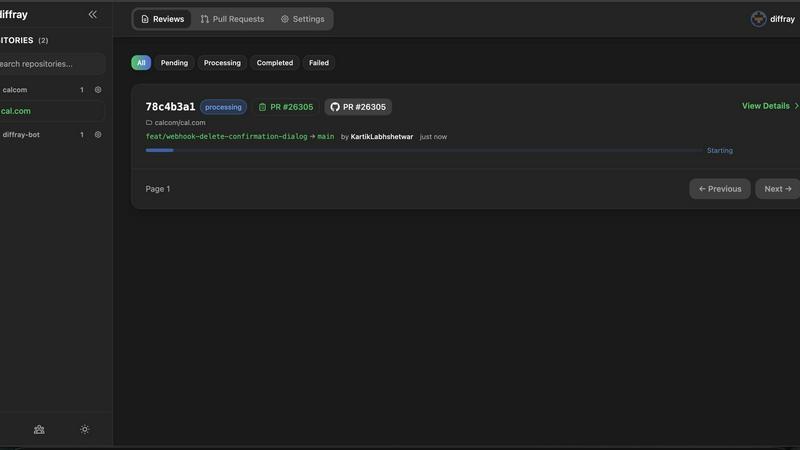
diffray
Fallom
Feature Comparison
diffray
Multi-Agent Architecture
diffray's innovative multi-agent architecture deploys over 30 specialized agents, each focused on unique aspects of code quality. This setup provides a comprehensive review process that addresses security, performance, bugs, and best practices, ensuring a thorough evaluation of code changes.
Reduced Noise in Pull Requests
By utilizing specialized agents, diffray significantly reduces the noise often associated with code reviews. Developers receive targeted insights, allowing them to concentrate on critical issues instead of sifting through irrelevant comments, thereby enhancing productivity and efficiency.
High Accuracy and Reduced False Positives
With an impressive 87 percent decrease in false positives, diffray ensures that development teams can trust the feedback they receive. This high accuracy means that genuine issues are prioritized, allowing teams to focus their efforts where it matters most and improving overall code quality.
Seamless Integration with Popular Platforms
diffray is designed to integrate effortlessly with leading version control platforms like GitHub, GitLab, and Bitbucket. This seamless integration allows teams to adopt diffray without disrupting their existing workflows, making it an ideal solution for any development environment.
Fallom
End-to-End LLM Tracing & Live Dashboard
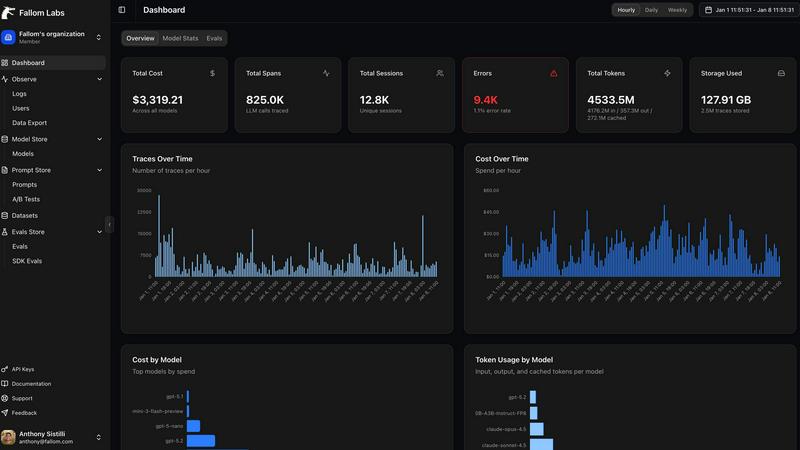
Gain real-time, granular visibility into every AI interaction. Fallom's live dashboard shows a streaming feed of all LLM calls, capturing the full context: the exact input prompt, the model used, token counts, latency, and calculated cost. You can click into any trace to see the complete chain, including intermediate steps and tool calls. This instant, detailed observability is critical for spotting anomalies, understanding user behavior, and ensuring your AI features are performing as expected in the wild.
Enterprise Compliance & Audit Trails
Navigate the complex landscape of AI regulation with confidence. Fallom is built for compliance, offering immutable, complete audit trails of every LLM interaction. This includes full input/output logging, model versioning, and user consent tracking—essential for adhering to the EU AI Act, GDPR, and SOC 2 requirements. A dedicated Privacy Mode allows you to disable content capture for sensitive data, maintaining full telemetry while protecting user privacy and confidential information.
Advanced Cost Attribution & Analytics
Take control of your spiraling AI spend. Fallom automatically attributes costs across every dimension: per model, per user, per team, and per customer. The platform provides clear dashboards and breakdowns, showing exactly where your budget is going. This enables precise budgeting, internal chargeback, and data-driven decisions on model selection, helping you optimize for both cost and performance without any financial blind spots.
Timing Waterfalls & Tool Call Visibility
Debug the performance of multi-step AI agents with surgical precision. Fallom's timing waterfall visualizations break down the latency of each step in an agent's workflow, instantly pinpointing whether delays are in LLM calls, tool executions (like database queries or API calls), or your own code. Combined with full visibility into every tool call's arguments and results, you can quickly identify and resolve bottlenecks that impact user experience.
Use Cases
diffray
Enhancing Code Quality for Startups
Startups often operate under tight deadlines and limited resources. diffray helps these teams maintain high code quality by providing accurate, actionable feedback on code changes, enabling faster iterations and reducing the risk of critical bugs in production.
Streamlining Code Reviews for Large Teams
In larger teams, code reviews can become bottlenecks. diffray accelerates the review process by minimizing noise and highlighting genuine issues, allowing teams to review code more efficiently and effectively, ultimately speeding up the development lifecycle.
Ensuring Compliance in Regulated Industries
For teams working in regulated industries, ensuring code compliance with established standards is crucial. diffray's specialized agents focus on security and best practices, helping teams identify and rectify compliance issues before they become costly problems.
Facilitating Continuous Integration and Deployment
diffray fits perfectly into CI/CD pipelines by providing real-time feedback on code changes. This ensures that code is consistently reviewed for quality before deployment, reducing the likelihood of introducing bugs into production environments and maintaining software reliability.
Fallom
Monitoring and Debugging Production AI Agents
When your customer-facing AI agent starts behaving oddly or timing out, you need answers fast. Fallom provides the complete picture, allowing you to trace a user's failed session end-to-end. See the exact prompts that led to an error, inspect the arguments passed to a faulty tool call, and analyze latency waterfalls to find the slow step. This turns hours of guesswork into minutes of targeted debugging, ensuring high reliability for your AI-powered features.
Ensuring Regulatory Compliance for AI Products
For companies in finance, healthcare, or any regulated industry, deploying AI comes with heavy compliance burdens. Fallom acts as your audit engine, automatically generating the required logs for every LLM interaction. You can prove which model version generated a specific output, demonstrate that user consent was captured, and maintain privacy-mode logs for sensitive operations, making audits for the EU AI Act or GDPR a streamlined process.
Controlling and Optimizing LLM Spend
With AI costs becoming a major line item, finance and engineering teams need transparency. Fallom answers critical questions: Is Team A's experimental feature burning budget on GPT-4? Which customer is the most expensive to serve? By providing detailed, attribute-level cost reporting, Fallom enables showback/chargeback models, helps teams choose cost-effective models for specific tasks, and identifies wasteful patterns before they impact the bottom line.
Performance Optimization and Model A/B Testing
Before rolling out a new, faster model like Claude 3.5 Sonnet, you need confidence it won't break things. Fallom's built-in A/B testing framework lets you safely split traffic between models, comparing their performance, cost, and output quality (via integrated evaluations) in real-time. Combined with timing waterfalls, you can validate latency improvements and switch traffic with confidence, ensuring continuous performance enhancement.
Overview
About diffray
diffray is a groundbreaking multi-agent AI code review tool designed to elevate the standards of code quality assurance in software development. Unlike traditional code review tools that typically use a single generic model, diffray harnesses the power of over 30 specialized agents, each meticulously crafted to assess distinct elements such as security vulnerabilities, performance issues, bugs, and adherence to best practices. This cutting-edge approach significantly minimizes noise in pull requests (PRs), enabling developers to focus on actionable insights rather than being overwhelmed by irrelevant feedback. With an astounding 87 percent reduction in false positives, diffray empowers teams to identify three times more genuine issues, ultimately leading to enhanced code reliability. Developers can anticipate a remarkable decline in PR review times, from an average of 45 minutes to just 12 minutes per week. Tailored for teams of all sizes, diffray seamlessly integrates with popular platforms like GitHub, GitLab, and Bitbucket, establishing itself as an essential tool for modern software development.
About Fallom
Fallom is the AI-native observability platform engineered for the new frontier of software: Large Language Model (LLM) and autonomous agent workloads. As enterprises rush to integrate generative AI into their core products, they're hitting a critical visibility wall. Traditional APM tools fall short, leaving teams flying blind on cost, performance, and compliance. Fallom shatters that barrier. It provides real-time, granular visibility into every single LLM call in production, delivering end-to-end tracing that captures prompts, outputs, tool calls, tokens, latency, and per-call costs. Built with enterprise-scale and regulatory rigor in mind, it adds crucial session, user, and customer-level context, transforming fragmented API calls into a coherent narrative of AI interactions. With its OpenTelemetry-native SDK, teams can instrument their entire AI stack in minutes, not months. Fallom is the definitive tool for engineering and product teams who need to monitor usage live, debug complex agentic workflows, attribute costs accurately, and maintain robust audit trails for frameworks like GDPR and the EU AI Act. It's not just monitoring; it's the command center for reliable, compliant, and cost-effective AI operations.
Frequently Asked Questions
diffray FAQ
What programming languages does diffray support?
diffray supports a wide range of programming languages, ensuring that it can be integrated into various development environments. Its flexibility allows teams to leverage its capabilities regardless of the technology stack they use.
How does diffray reduce false positives?
diffray significantly reduces false positives by employing over 30 specialized agents that are tailored to focus on specific aspects of code quality. This targeted approach ensures that feedback is relevant and actionable, leading to more accurate reviews.
Can diffray be used with existing workflows?
Absolutely! diffray is designed to integrate seamlessly with popular version control platforms like GitHub, GitLab, and Bitbucket. This means that teams can easily incorporate diffray into their existing workflows without any disruption.
Is diffray suitable for small teams?
Yes, diffray is designed for teams of all sizes. Whether you are a startup or a large enterprise, diffray provides valuable insights that enhance code quality and streamline the review process, making it an excellent choice for any development team.
Fallom FAQ
How does Fallom integrate with my existing AI stack?
Fallom is built on OpenTelemetry, the open standard for observability. Integration is simple: add Fallom's single, lightweight SDK to your application. It automatically instruments calls to all major LLM providers (OpenAI, Anthropic, Google, etc.) and custom agents without vendor lock-in. You can be tracing live calls in under 5 minutes, with no changes to your core application logic.
How does Fallom handle sensitive or private user data?
Security and privacy are paramount. Fallom offers a configurable Privacy Mode. When enabled, you can choose to redact specific data fields, log only metadata (like token counts and latency), or disable content capture entirely for sensitive environments. This ensures you maintain full observability for performance and cost while complying with strict data protection policies.
Can I use Fallom to test and evaluate my LLM prompts?
Absolutely. Fallom includes a Prompt Store for versioning and managing your prompts. You can A/B test different prompt variations directly within the platform, deploying winning versions instantly. Furthermore, you can run automated evaluations (for accuracy, relevance, hallucination rates, etc.) on LLM outputs to catch regressions before they reach production users.
Is Fallom suitable for small startups or only large enterprises?
Fallom is built to scale from fast-moving startups to global enterprises. It offers a free tier to get started, which is perfect for small teams to gain immediate visibility. As your AI usage grows, its enterprise features—like advanced cost attribution, session tracking, and compliance tooling—become essential for managing complexity, cost, and risk at scale.
Alternatives
diffray Alternatives
diffray is a state-of-the-art multi-agent AI code review tool designed to enhance code quality assurance in software development. Utilizing over 30 specialized agents, diffray provides tailored insights into aspects such as security, performance, and best practices, creating a more efficient review process. Users often seek alternatives to diffray for various reasons, including budget constraints, specific feature needs, or compatibility with different development platforms. When exploring alternatives, it's essential to consider factors such as integration capabilities, the quality of feedback, and the tool's adaptability to your unique project requirements.
Fallom Alternatives
Fallom is a leading AI-native observability platform, squarely in the category of tools designed for monitoring, debugging, and managing LLM and AI agent workloads in production. As this space explodes, teams are actively scouting the landscape for options that better fit their specific stack, budget constraints, or require a different blend of features like deeper integration with existing APM tools or more granular data retention policies. When evaluating alternatives, the key is to match the tool to your operational reality. Look for robust real-time tracing that covers the full agent chain—prompts, tool calls, and costs. Enterprise teams must prioritize compliance readiness with audit trails and session context, while startups might seek more flexible pricing. The ideal platform should integrate seamlessly without becoming a development bottleneck. Ultimately, the right observability solution should turn opaque AI operations into a clear, actionable dashboard. It's not just about logging calls; it's about gaining the insights to improve performance, control spend, and ensure reliable, compliant AI deployments that scale with your ambitions.