
HookMesh vs qtrl.ai
Side-by-side comparison to help you choose the right tool.

HookMesh delivers reliable webhooks with automatic retries and a self-service customer portal for SaaS.
Last updated: February 28, 2026

qtrl.ai
Scale QA with AI agents while keeping full control and governance.
Last updated: March 4, 2026
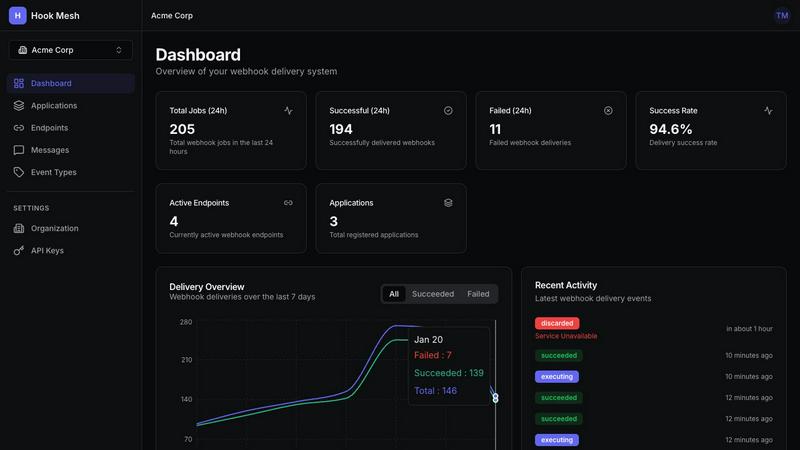
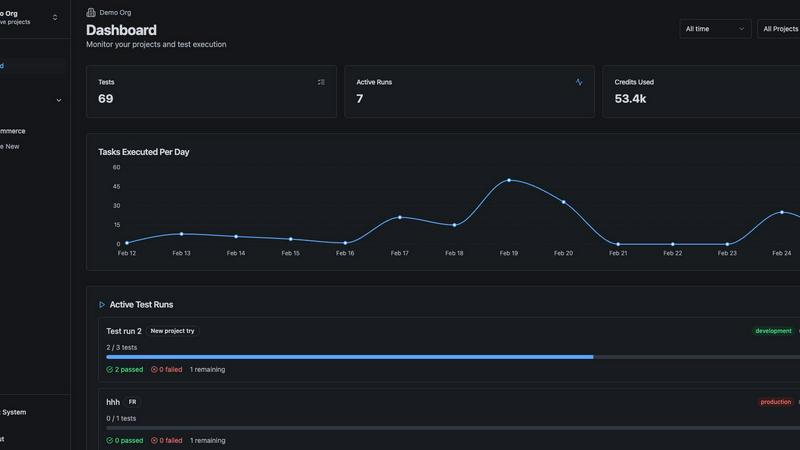
Visual Comparison
HookMesh
qtrl.ai
Feature Comparison
HookMesh
Reliable Delivery Engine
HookMesh's core is a battle-tested delivery system designed for the unpredictable nature of the web. It guarantees at-least-once delivery using idempotency keys, ensuring no event is lost even during retries. The system employs sophisticated exponential backoff with jitter, intelligently retrying failed deliveries for up to 48 hours without overwhelming downstream endpoints. An automatic circuit breaker proactively disables endpoints that are consistently failing, preventing one problematic customer from backing up your entire queue and affecting others' delivery performance.
Self-Service Customer Portal
Shift the burden of endpoint management from your support team directly to your users with HookMesh's embeddable customer portal. This white-labeled UI can be dropped directly into your application, providing your customers with full autonomy. They can add, verify, and manage their own webhook endpoints, view complete delivery logs with request and response details, and instantly replay any failed webhook with one click. This dramatically reduces support tickets and increases customer satisfaction through transparency.
Developer-First SDKs & Tools
HookMesh is built to integrate in minutes, not months. It offers official, well-maintained SDKs for popular languages like JavaScript, Python, and Go, allowing you to send events with just a few lines of code. Beyond the SDKs, developers get access to a full REST API for programmatic control and a Webhook Playground to test, debug, and validate event payloads and signatures before going live, ensuring a smooth development and debugging experience.
Comprehensive Visibility & Control
Gain operational mastery over your webhook ecosystem. HookMesh provides detailed delivery logs with full HTTP request and response traces, eliminating the need to dig through server logs for hours. Combined with the customer portal, this creates a transparent feedback loop. Furthermore, features like configurable retry policies, event replay, and webhook signature verification give you and your customers complete control and confidence in the delivery pipeline.
qtrl.ai
Autonomous QA Agents
Move beyond script maintenance nightmares. qtrl.ai deploys intelligent agents that operate on-demand or continuously, executing precise instructions across multiple environments at scale. Crucially, they work within your defined rules and execute in real browsers, not simulations, ensuring authentic user experience validation. This is AI you can actually trust to handle repetitive, complex workflows without going rogue.
Enterprise-Grade Test Management
Governance isn't an afterthought—it's the core. qtrl.ai provides a centralized command hub for all QA activities. Structure test cases, plans, and runs with full traceability from requirement to release. Built-in audit trails and compliance-ready workflows ensure every change is tracked, making it the secure, single source of truth for engineering leads and QA managers demanding visibility and control.
Progressive Automation
Ditch the all-or-nothing AI dilemma. qtrl.ai’s philosophy is gradual empowerment. Start by writing high-level test instructions yourself. Then, seamlessly transition to letting AI generate detailed tests from your requirements—all fully reviewable and approvable. The platform even analyzes coverage gaps and suggests new tests, putting you in the driver's seat for every step toward increased automation.
Adaptive Memory & Multi-Environment Execution
This is where qtrl.ai gets smarter with every interaction. Its Adaptive Memory builds a living knowledge base of your application, learning from exploration and test runs to power context-aware test generation. Coupled with robust multi-environment execution—supporting dev, staging, and prod with per-environment variables and encrypted secrets—it ensures tests are both intelligent and executed securely where it matters.
Use Cases
HookMesh
SaaS Platform Notifications
For platforms like project management tools, CRM systems, or financial dashboards, real-time notifications are critical. HookMesh enables these platforms to reliably push events—like a new comment, a deal stage change, or a budget alert—to their customers' external systems. The self-service portal allows customers to set up their own integrations without requiring platform developers to manually configure each endpoint, enabling massive scalability.
E-commerce & Payment Processing
E-commerce engines and payment processors need guaranteed delivery of order confirmations, shipment updates, and payment success/failure events to merchant ERPs, accounting software, and logistics systems. HookMesh's at-least-once delivery and 48-hour retry logic ensure critical financial and operational data is never lost, even if the merchant's system experiences temporary downtime.
DevOps & CI/CD Automation
Modern DevOps teams use webhooks to trigger pipelines, deployments, and alerts across tools like GitHub, GitLab, and monitoring platforms. HookMesh ensures these automation triggers are never missed. If a deployment orchestration tool is temporarily unavailable, HookMesh will persistently retry, preventing automation breakdowns and maintaining continuous delivery flows without manual intervention.
IoT & Real-Time Data Streaming
IoT platforms that aggregate sensor data and need to forward processed events to customer applications or data lakes require a robust, fire-and-forget delivery system. HookMesh handles the high volume and variable connectivity of IoT endpoints, using circuit breakers to sideline unresponsive receivers and ensuring data flows consistently to all active and healthy systems.
qtrl.ai
Scaling Beyond Manual Testing
For QA teams drowning in repetitive manual checklists, qtrl.ai is the lifeline. It allows teams to start by structuring their existing manual cases in the platform, then progressively automate the most tedious flows using AI agents. This creates immediate efficiency gains, frees up human testers for complex exploratory work, and provides a clear, manageable path to a hybrid automation strategy without a risky, overnight overhaul.
Modernizing Legacy QA Workflows
Companies stuck with fragmented tools—separate test case repos, siloed automation scripts, and manual reporting—can consolidate onto qtrl.ai. It replaces the patchwork with a unified platform that integrates test management, automation, and execution. This breaks down silos, introduces much-needed traceability and auditability, and injects modern AI capabilities into outdated processes, all while maintaining strict governance.
Governing Enterprise AI Testing
Enterprises that want to leverage AI but cannot afford "black-box" unpredictability find their solution here. qtrl.ai offers permissioned autonomy levels and full agent visibility, ensuring AI operates within strict compliance guardrails. Teams can leverage AI for test generation and execution at scale across global browsers, all while maintaining full audit trails, satisfying security reviews, and meeting rigorous regulatory requirements.
Empowering Product-Led Engineering Teams
Development teams embracing a product-led growth model need quality to keep pace with rapid, user-focused iteration. qtrl.ai integrates directly into CI/CD pipelines, providing continuous quality feedback. Engineers can write high-level test instructions or connect requirements, and qtrl.ai handles the rest, ensuring new features are validated quickly and reliably without creating automation debt, thus accelerating release cycles safely.
Overview
About HookMesh
In the fast-paced world of modern SaaS, real-time data flow isn't a luxury—it's the lifeblood of user experience and system integration. Yet, building the infrastructure to power this, specifically webhooks, is a notorious time-sink that derails developer velocity. Enter HookMesh: the battle-tested, developer-first platform engineered to eliminate the chaos of in-house webhook delivery. This isn't just another middleware; it's a complete operational shift. HookMesh provides the robust, scalable infrastructure so your team can stop worrying about retry logic, circuit breakers, and debugging "ghost" deliveries, and start focusing on your core product innovation. Designed for developers and product teams at scaling SaaS companies, HookMesh delivers peace of mind through guaranteed reliability and unparalleled visibility. Its killer feature? A fully embeddable, self-service customer portal that turns webhook management from a support nightmare into a user empowerment tool, allowing your customers to manage endpoints, view live logs, and replay failures with a single click. In an era where API reliability is a direct reflection of your brand, HookMesh ensures your event-driven architecture is a competitive advantage, not a technical debt trap.
About qtrl.ai
The QA landscape is at a breaking point. Manual testing crumbles under agile velocity, while traditional automation is a brittle, resource-heavy beast. Enter qtrl.ai, the definitive answer for teams refusing to compromise. This isn't just another test runner; it's a progressive AI-powered QA platform engineered to scale quality intelligently, without the terrifying "black-box" risks of fully autonomous AI. qtrl.ai masterfully bridges the critical gap, offering enterprise-grade test management as its rock-solid foundation. Here, teams organize test cases, plan runs, trace requirements, and track real-time metrics with full governance. But the real game-changer is its layered AI. You start with total control—simple manual management or human-written instructions. When ready, you progressively unlock autonomous agents that generate and maintain UI tests from plain English, executing them at scale across real browsers. Built for product-led engineering teams, QA groups scaling beyond manual, and compliance-focused enterprises, qtrl.ai delivers a trusted, transparent path from structured oversight to intelligent automation. It’s the control tower for modern quality assurance.
Frequently Asked Questions
HookMesh FAQ
How does HookMesh guarantee webhook delivery?
HookMesh guarantees at-least-once delivery through a combination of persistent queues, automatic retries with exponential backoff and jitter for up to 48 hours, and idempotency keys. The idempotency keys ensure that even if a retry is sent, the receiving server can recognize it as a duplicate and not process it twice, preventing side effects while ensuring the payload is delivered.
What is the self-service portal and how do I implement it?
The self-service portal is a fully embeddable UI component you can integrate into your own application's settings or dashboard. It allows your end-users to manage their own webhook endpoints, view delivery logs, and replay failures. Implementation typically involves adding a few lines of JavaScript to your frontend code, which securely loads the portal configured for your specific HookMesh account and customer context.
Can I test webhooks before sending them to live endpoints?
Absolutely. HookMesh provides a Developer Playground within its dashboard. This tool allows you to construct test event payloads, send them through the HookMesh system, and inspect the entire delivery journey—including signature generation and simulated retry logic—without affecting any live customer endpoints. It's perfect for debugging and validating your integration.
What happens if my customer's endpoint is down for an extended period?
HookMesh's intelligent circuit breaker automatically detects endpoints that are consistently failing (e.g., returning 5xx errors or timing out). It will temporarily disable delivery to that endpoint to prevent queue backups. The system continues to retry at increasing intervals. Once the endpoint begins to respond successfully again, HookMesh automatically re-enables delivery and will attempt to send any queued events from the disabled period, subject to your retry policy window.
qtrl.ai FAQ
How does qtrl.ai's AI differ from other "autonomous" testing tools?
Alert: Many tools force a risky, AI-first approach where the AI makes opaque decisions. qtrl.ai is built on a principle of "permissioned autonomy." Its AI agents operate strictly within rules and instructions you define. You maintain full visibility into every action, and all AI-generated tests are reviewable and approvable. It's AI augmentation, not AI replacement, designed to earn trust through transparency and control.
Can we use qtrl.ai if we currently only do manual testing?
Absolutely, and that's the recommended starting point. qtrl.ai's platform is designed for progression. You can begin by using its robust test management features to organize and execute your manual test cases and plans. This gives you immediate value and a structured foundation. When your team is ready, you can gradually introduce AI-powered automation for specific flows, all within the same centralized platform.
Is our data secure, especially when using AI agents?
Security is non-negotiable. qtrl.ai is built with enterprise-grade safeguards. For AI operations, your application secrets and sensitive environment variables are encrypted and never exposed to the AI agents. The platform operates with full audit trails and is designed for compliance. You maintain sovereignty over your data and test assets at all times, with granular control over who can access and trigger automation.
How does qtrl.ai handle tests when our application UI changes?
This is a classic automation pain point. qtrl.ai's Adaptive Memory and intelligent agents are designed for resilience. The system learns from your application and past test executions. When changes occur, the AI can often suggest maintenance actions or adapt tests based on context. Furthermore, because you start with high-level instructions (e.g., "log in as a customer"), rather than brittle, code-level selectors, tests are more durable and easier to update.
Alternatives
HookMesh Alternatives
HookMesh is a specialized platform in the developer tools category, designed to automate and guarantee webhook delivery for SaaS applications. It solves the engineering burden of building in-house systems for retries, debugging, and customer management, letting teams focus on their core product. Users often explore alternatives for several key reasons. These include budget constraints and pricing model fit, the need for specific integrations or platform-native tools, or requirements for more advanced features like custom transformation logic. The search for the right tool is a common step in optimizing a tech stack. When evaluating options, prioritize proven reliability with automatic retries, a strong developer experience for easy integration, and transparency features like customer-facing logs. The goal is to find a solution that removes operational headaches without introducing new complexity.
qtrl.ai Alternatives
qtrl.ai is a trending AI-powered QA platform in the automation and dev tools space. It helps teams scale testing with intelligent agents while maintaining crucial governance and control over the entire process. This hybrid approach is gaining traction as teams seek to modernize without the risks of full AI autonomy. Users often explore alternatives for several key reasons. Budget constraints, specific integration needs with existing CI/CD pipelines, or a desire for a different balance between AI automation and traditional scripting can drive the search. The need for specialized testing types, like performance or security, also plays a role. When evaluating other options, focus on the core pillars: governance, integration depth, and AI transparency. Look for platforms that offer robust audit trails, seamless fit with your tech stack, and clear visibility into how AI agents generate and maintain tests. The goal is to accelerate release cycles without introducing new bottlenecks or compliance headaches.