
HookMesh vs TrafficClaw
Side-by-side comparison to help you choose the right tool.

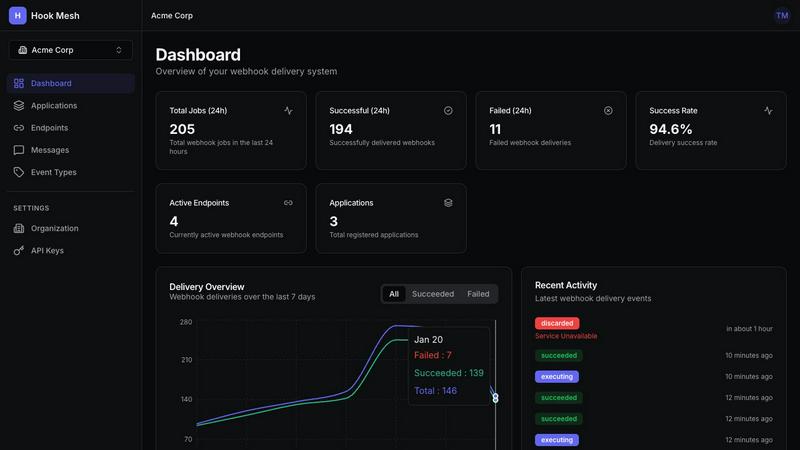
HookMesh delivers reliable webhooks with automatic retries and a self-service customer portal for SaaS.
Last updated: February 28, 2026

TrafficClaw
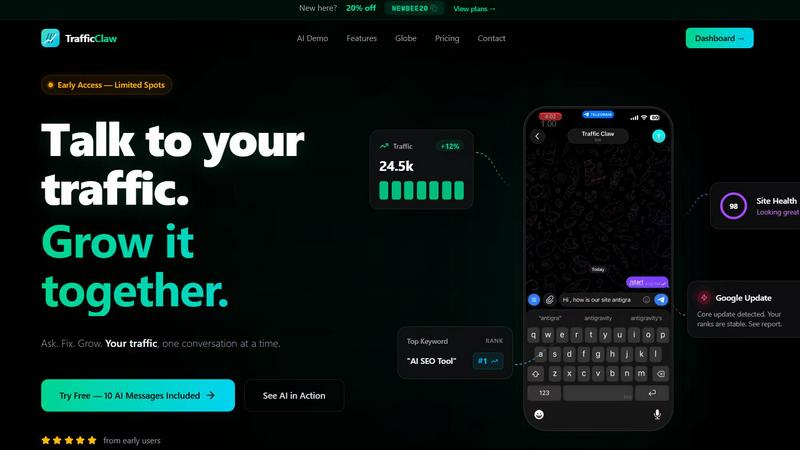
TrafficClaw is your AI analyst that talks to your live SEO data to deliver actionable growth verdicts instantly.
Last updated: April 13, 2026
Visual Comparison
HookMesh
TrafficClaw
Feature Comparison
HookMesh
Reliable Delivery Engine
HookMesh's core is a battle-tested delivery system designed for the unpredictable nature of the web. It guarantees at-least-once delivery using idempotency keys, ensuring no event is lost even during retries. The system employs sophisticated exponential backoff with jitter, intelligently retrying failed deliveries for up to 48 hours without overwhelming downstream endpoints. An automatic circuit breaker proactively disables endpoints that are consistently failing, preventing one problematic customer from backing up your entire queue and affecting others' delivery performance.
Self-Service Customer Portal
Shift the burden of endpoint management from your support team directly to your users with HookMesh's embeddable customer portal. This white-labeled UI can be dropped directly into your application, providing your customers with full autonomy. They can add, verify, and manage their own webhook endpoints, view complete delivery logs with request and response details, and instantly replay any failed webhook with one click. This dramatically reduces support tickets and increases customer satisfaction through transparency.
Developer-First SDKs & Tools
HookMesh is built to integrate in minutes, not months. It offers official, well-maintained SDKs for popular languages like JavaScript, Python, and Go, allowing you to send events with just a few lines of code. Beyond the SDKs, developers get access to a full REST API for programmatic control and a Webhook Playground to test, debug, and validate event payloads and signatures before going live, ensuring a smooth development and debugging experience.
Comprehensive Visibility & Control
Gain operational mastery over your webhook ecosystem. HookMesh provides detailed delivery logs with full HTTP request and response traces, eliminating the need to dig through server logs for hours. Combined with the customer portal, this creates a transparent feedback loop. Furthermore, features like configurable retry policies, event replay, and webhook signature verification give you and your customers complete control and confidence in the delivery pipeline.
TrafficClaw
AI Analyst Chat
This is your core interface for growth. Ask any question about your traffic, rankings, or site performance in natural language. The AI doesn't just summarize data; it analyzes your connected GA4 and Search Console data to diagnose issues, spot trends, and provide specific, actionable verdicts. Get instant answers, supporting charts, and clear next steps, turning complex analytics into a simple conversation.
SEO Intelligence Engine
Go beyond basic rank tracking. This suite proactively monitors your SEO health, alerting you to critical issues like content decay, keyword cannibalization between your own pages, and undiscovered keyword gaps. It also includes an AEO (Answer Engine Optimization) engine, helping you structure content for visibility in AI-powered search experiences from Google's Gemini and others.
Real-Time Analytics & Embeddable Globe
See live visitor activity, traffic sources, and geographic distribution on a beautiful, interactive 3D globe within your dashboard. Uniquely, you can embed this live globe on your own website with a single iframe, showcasing real-time GA4-powered visitor activity without adding any tracking scripts. It's social proof and a data visualization tool in one.
Automated Site Audit & Content Tools
Run deep, page-level technical SEO audits that score performance, Core Web Vitals, and on-page factors, delivering auto-fix suggestions. The integrated content toolkit assists creation with an AI schema generator, blog writer, keyword researcher, and internal linking optimizer, bridging the gap between insight and execution.
Use Cases
HookMesh
SaaS Platform Notifications
For platforms like project management tools, CRM systems, or financial dashboards, real-time notifications are critical. HookMesh enables these platforms to reliably push events—like a new comment, a deal stage change, or a budget alert—to their customers' external systems. The self-service portal allows customers to set up their own integrations without requiring platform developers to manually configure each endpoint, enabling massive scalability.
E-commerce & Payment Processing
E-commerce engines and payment processors need guaranteed delivery of order confirmations, shipment updates, and payment success/failure events to merchant ERPs, accounting software, and logistics systems. HookMesh's at-least-once delivery and 48-hour retry logic ensure critical financial and operational data is never lost, even if the merchant's system experiences temporary downtime.
DevOps & CI/CD Automation
Modern DevOps teams use webhooks to trigger pipelines, deployments, and alerts across tools like GitHub, GitLab, and monitoring platforms. HookMesh ensures these automation triggers are never missed. If a deployment orchestration tool is temporarily unavailable, HookMesh will persistently retry, preventing automation breakdowns and maintaining continuous delivery flows without manual intervention.
IoT & Real-Time Data Streaming
IoT platforms that aggregate sensor data and need to forward processed events to customer applications or data lakes require a robust, fire-and-forget delivery system. HookMesh handles the high volume and variable connectivity of IoT endpoints, using circuit breakers to sideline unresponsive receivers and ensuring data flows consistently to all active and healthy systems.
TrafficClaw
Diagnosing Sudden Traffic Drops
Instead of manually correlating data across tools, you directly ask the AI Analyst "Why did my traffic drop 40% yesterday?" It analyzes your data, detects a recent Google Core Update, confirms your ranks are stable, and identifies a specific referring domain that stopped sending traffic, providing a clear, evidence-based verdict in seconds.
Preventing SEO Cannibalization
The SEO Intelligence engine continuously scans your content to identify pages targeting the same keywords. It alerts you to internal competition, explaining which pages are cannibalizing each other and providing specific recommendations to consolidate or differentiate content, preserving your search rankings.
Generating Actionable Content Briefs
When planning new content, ask the AI to "find keyword gaps in my niche." It analyzes your current rankings versus competitors and surfaces high-opportunity, low-difficulty keywords. Use the integrated content tools to then generate an optimized article outline and structured data markup for the new topic.
Real-Time Website Engagement
Embed the live visitor globe on your site's homepage or status page. This creates an engaging, dynamic element that shows real human activity, builds trust with visitors by demonstrating an active user base, and provides you with a public-facing view of your traffic's geographic reach.
Overview
About HookMesh
In the fast-paced world of modern SaaS, real-time data flow isn't a luxury—it's the lifeblood of user experience and system integration. Yet, building the infrastructure to power this, specifically webhooks, is a notorious time-sink that derails developer velocity. Enter HookMesh: the battle-tested, developer-first platform engineered to eliminate the chaos of in-house webhook delivery. This isn't just another middleware; it's a complete operational shift. HookMesh provides the robust, scalable infrastructure so your team can stop worrying about retry logic, circuit breakers, and debugging "ghost" deliveries, and start focusing on your core product innovation. Designed for developers and product teams at scaling SaaS companies, HookMesh delivers peace of mind through guaranteed reliability and unparalleled visibility. Its killer feature? A fully embeddable, self-service customer portal that turns webhook management from a support nightmare into a user empowerment tool, allowing your customers to manage endpoints, view live logs, and replay failures with a single click. In an era where API reliability is a direct reflection of your brand, HookMesh ensures your event-driven architecture is a competitive advantage, not a technical debt trap.
About TrafficClaw
Stop guessing why your traffic changes. TrafficClaw is the AI-powered command center that transforms your raw analytics and SEO data into direct, actionable conversations. Built for developers, marketers, and founders, it cuts through the noise of generic dashboards. Simply connect your Google Analytics 4 and Search Console accounts, then ask questions in plain English like "Why did my traffic drop last Tuesday?" or "What's my top keyword opportunity?" The AI Analyst digs into your live data, cross-referencing trends, updates, and page performance to deliver specific verdicts with evidence, not vague advice. It's about moving from passive data observation to active growth collaboration. Beyond the chat, TrafficClaw consolidates everything into one intelligent interface featuring real-time dashboards, automated SEO audits, content tools, and even a live visitor globe you can embed. This is the next evolution of web analytics: a proactive, AI-native partner designed to help you ask, fix, and grow your traffic in real time.
Frequently Asked Questions
HookMesh FAQ
How does HookMesh guarantee webhook delivery?
HookMesh guarantees at-least-once delivery through a combination of persistent queues, automatic retries with exponential backoff and jitter for up to 48 hours, and idempotency keys. The idempotency keys ensure that even if a retry is sent, the receiving server can recognize it as a duplicate and not process it twice, preventing side effects while ensuring the payload is delivered.
What is the self-service portal and how do I implement it?
The self-service portal is a fully embeddable UI component you can integrate into your own application's settings or dashboard. It allows your end-users to manage their own webhook endpoints, view delivery logs, and replay failures. Implementation typically involves adding a few lines of JavaScript to your frontend code, which securely loads the portal configured for your specific HookMesh account and customer context.
Can I test webhooks before sending them to live endpoints?
Absolutely. HookMesh provides a Developer Playground within its dashboard. This tool allows you to construct test event payloads, send them through the HookMesh system, and inspect the entire delivery journey—including signature generation and simulated retry logic—without affecting any live customer endpoints. It's perfect for debugging and validating your integration.
What happens if my customer's endpoint is down for an extended period?
HookMesh's intelligent circuit breaker automatically detects endpoints that are consistently failing (e.g., returning 5xx errors or timing out). It will temporarily disable delivery to that endpoint to prevent queue backups. The system continues to retry at increasing intervals. Once the endpoint begins to respond successfully again, HookMesh automatically re-enables delivery and will attempt to send any queued events from the disabled period, subject to your retry policy window.
TrafficClaw FAQ
How does TrafficClaw access and use my data?
TrafficClaw uses secure, read-only Google OAuth to connect to your GA4 and Search Console. This means we can view your analytics and search data but cannot edit, delete, or modify anything in your Google accounts. Your data is processed to generate insights but remains yours, and we do not sell it.
What makes the AI advice better than generic tips?
The AI Analyst is fundamentally different because it is context-aware with your data. Instead of giving broad advice like "improve your Core Web Vitals," it analyzes your specific page performance, identifies your slowest pages, and provides the exact fixes needed for your site, backed by your own metrics.
Is there a setup or configuration required?
Setup takes less than a minute. After signing in with Google, TrafficClaw auto-detects your connected GA4 properties and Search Console sites. Your dashboard and AI chat are populated instantly with real data, requiring zero manual configuration or code implementation to start.
Can I use the embeddable globe on any website?
Yes. The live visitor globe is a standalone iframe widget that can be embedded on any website, CMS (like WordPress), or custom framework. It simply requires pasting one line of code. The globe pulls real-time data from your connected GA4 property without needing to install separate tracking scripts on the embedding site.
Alternatives
HookMesh Alternatives
HookMesh is a specialized platform in the developer tools category, designed to automate and guarantee webhook delivery for SaaS applications. It solves the engineering burden of building in-house systems for retries, debugging, and customer management, letting teams focus on their core product. Users often explore alternatives for several key reasons. These include budget constraints and pricing model fit, the need for specific integrations or platform-native tools, or requirements for more advanced features like custom transformation logic. The search for the right tool is a common step in optimizing a tech stack. When evaluating options, prioritize proven reliability with automatic retries, a strong developer experience for easy integration, and transparency features like customer-facing logs. The goal is to find a solution that removes operational headaches without introducing new complexity.
TrafficClaw Alternatives
TrafficClaw is a conversational AI assistant for SEO and analytics. It sits at the red-hot intersection of generative AI and data analytics, allowing you to simply ask questions about your traffic and get actionable answers pulled directly from your connected data sources like GA4 and Search Console. Users explore alternatives for various reasons. Some need a solution that integrates with a broader martech stack, while others prioritize specific features like automated reporting or competitive intelligence. Budget considerations and the desire for a different user experience also drive the search for other tools in this emerging category. When evaluating other options in this space, focus on core capabilities. Key considerations include the depth of AI interpretation, the range of native data integrations, the specificity and actionability of insights provided, and of course, the overall value relative to the investment. The goal is to move beyond static graphs into a dynamic, conversational analysis of your performance.