
Disavow.ai vs Oleno
Side-by-side comparison to help you choose the right tool.

Disavow.ai
Find toxic links, disavow. Easy & budget-friendly.

Oleno
Oleno automates on-brand content creation, bridging your demand generation gaps for better SEO and visibility.
Last updated: March 1, 2026
Visual Comparison
Disavow.ai
Oleno
Overview
About Disavow.ai
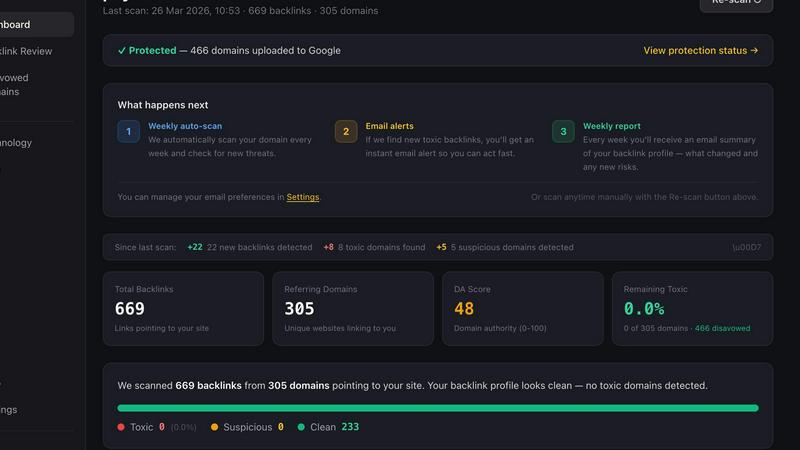
Every website picks up backlinks it didn't ask for — spam networks, link farms, scraper sites. When they cause a Google penalty or tank your rankings, you need to act fast. Disavow.ai scans your backlink profile, classifies every linking domain as clean, suspicious, or toxic using a 4-layer Smart Risk Engine, and generates the exact file Google needs to ignore the bad ones. Toxic domains are grouped into plain-English categories — Spam & Link Farms, Private Blog Networks, Known Spam Patterns, Risky Extensions, and Near-Zero Authority — each showing exactly why it was flagged. No SEO jargon, no black-box scores. Free tier lets you scan and see 15 backlinks. Pro at $39/mo gives you unlimited backlinks, full export, and weekly auto-scans. That's 70% less than Semrush for the same core functionality.
About Oleno
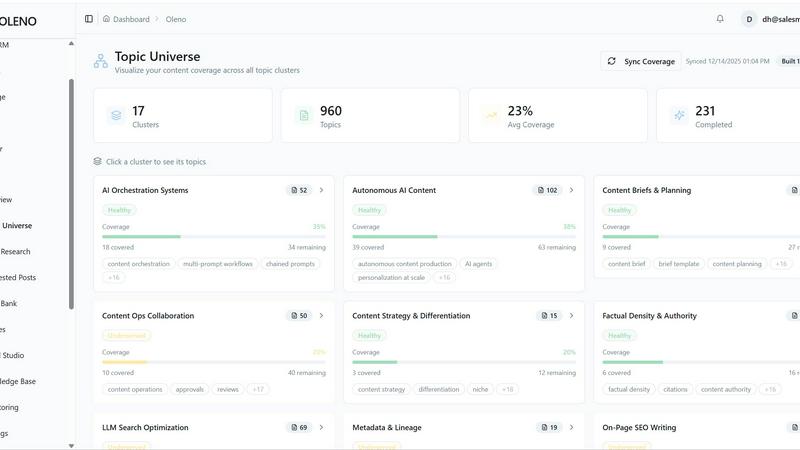
Oleno is an innovative autonomous content engine meticulously designed to revolutionize programmatic SEO and enhance the visibility of citations in large language models (LLMs). Unlike conventional content tools that solely focus on article generation, Oleno functions as a holistic system that identifies relevant topics from your sitemap while grounding each piece of content in your unique knowledge base. This ensures that the material produced is not only tailored to your brand's voice but is also optimized for search engines, thereby improving rankings and increasing citation rates by advanced AI models like ChatGPT, Perplexity, and Claude. Targeted at B2B teams striving for organic growth, Oleno streamlines content operations by integrating your brand narrative and voice into every article. With over 80 quality assurance checks for accuracy and compliance, Oleno eliminates the cumbersome processes associated with fragmented content operations. This allows teams to effectively close the content gap and scale their efforts more intelligently and efficiently than ever before.